Senior Design
Introduction
Hand Sensory Rehabilitation for Stroke Patients: This project, motivated and advised by Dr. Sanford Meek, and Dr. Mohommed Sbai, culminated my bachelor's degree in Mechanical Engineering. In some stroke patients, the cortical pathways in the affected side of the body can become jumbled. From the perspective of the stroke patient, this means that physical stimuli located on the pinky finger might be perceived as occurring on the thumb, and vice-versa.
Over the span of two semesters, I worked in a group to understand the needs of potential users, and realized a wearable haptic device for sensory rehabilitation in stroke patients. The solution we created is intended to be used both in a clinical setting by a physical therapist and by the stroke patient themself at home.
The wearable portion of the device, which contains twenty vibrational motor-LED pairs, is applied to the affected hand, with operation controlled via a graphical user interface on a connected computer. Each vibrational motor-LED pair can be individually activated, or the pairs can be activated in groups (i.e., individual fingers, or the palm). Upon activation, the LED illuminates, and the vibrational motor vibrates (with pulse duration and intensity controlable). The therapist (or other user) can activate these vibrational motor-LED pairs in the fashion of a quiz, with the patient (hopefully) learning to correctly identify the location of the stimuli over time.
My Contributions
Within this project, I championed the electrical design and created the initial Arduino software used to tune the device (it was later ported over to LabView to achieve the graphical user interface).
Control of the vibrational motor-LED pairs occurrs via multiplexing; that is, any individual motor-LED pair can be individually activated by energizing the corresponding voltage and ground connections. The graphic below gives an abstracted explanation.
At the deeper level, here is the resulting electrical schematic, ECAD drawing for the printed circuit board (PCB) design, and the physical PCB populated with components.
Electrical schematic; created using EasyEDA.
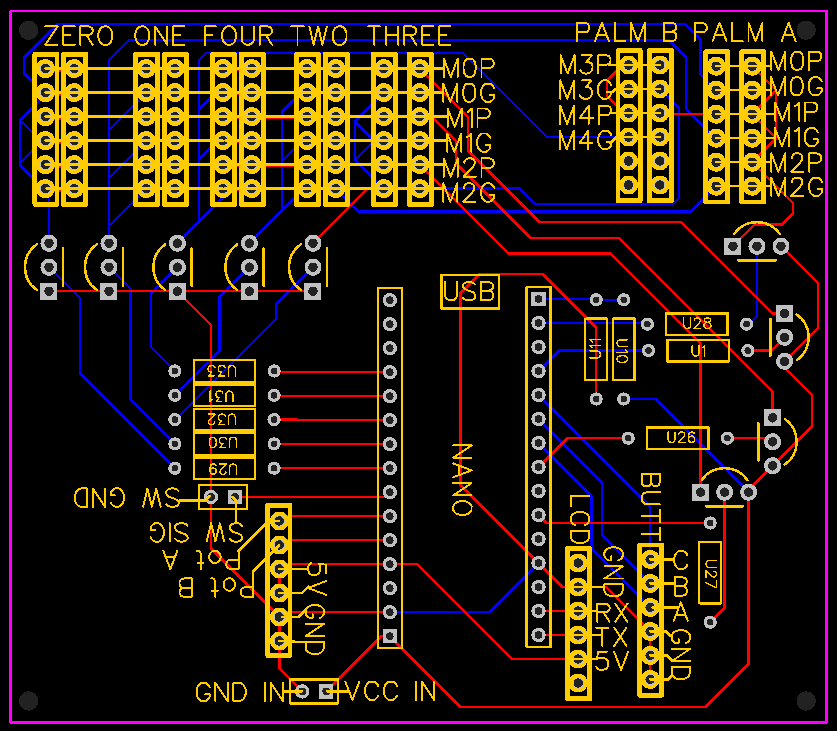
ECAD drawing of the PCB for routing power and signals; created using EasyEDA.
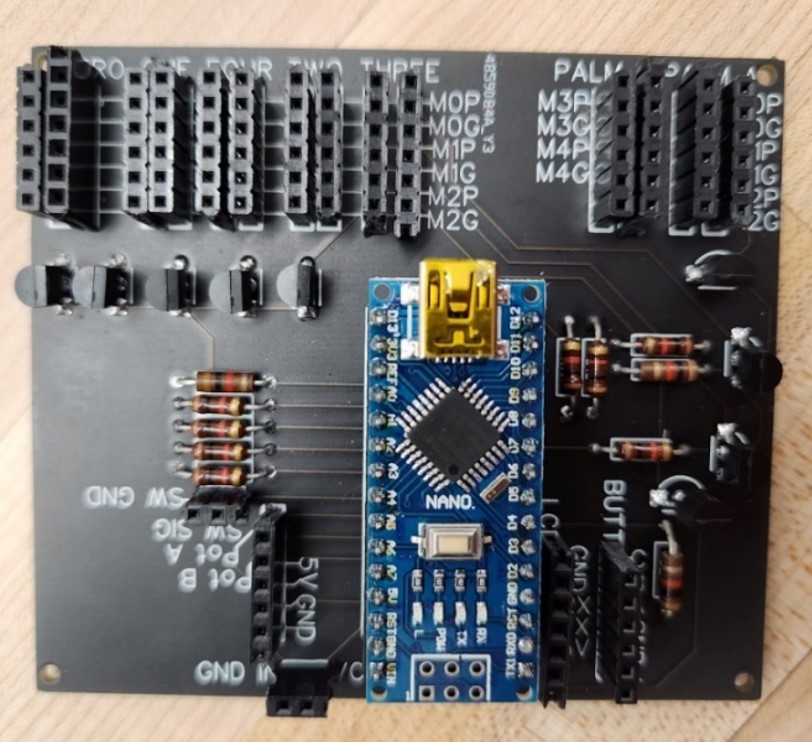
The physical PCB, populated with an Arduino NANO microcontroller, and all the necessary components.
Design Day
The Department of Mechanical Engineering holds a public event every semester called Design Day. At Design Day, any courses involving competitions are held, and the Senior Design groups present their projects via poster and any relevant physical demonstrations. For our demonstrations, we displayed the wearable haptic device on a 3D-printed hand, and allowed curious attendees to wear the device, and control it via the graphical user interface.
The Design Day poster explaining our project.
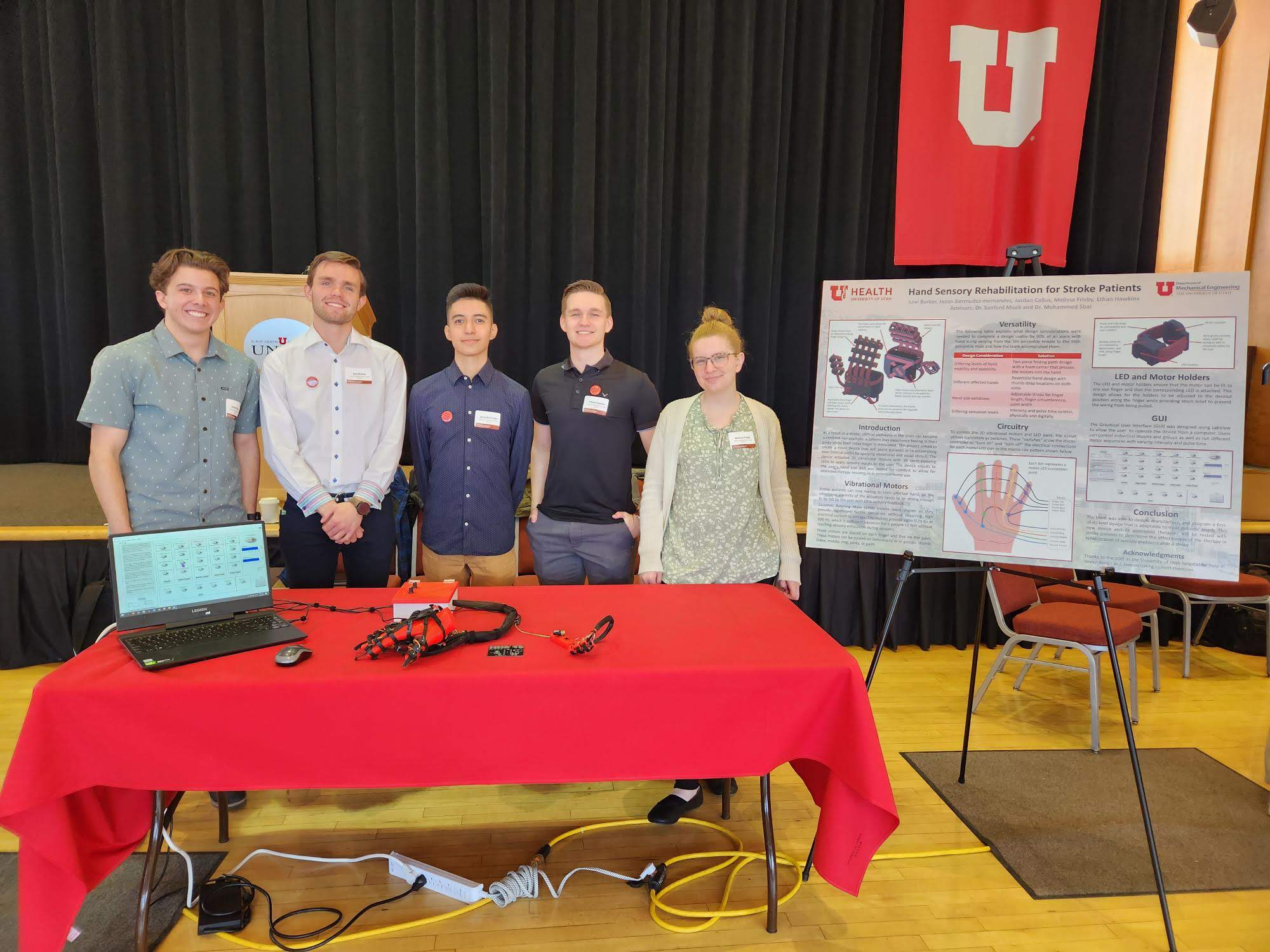
Group photo next to the Design Day poster; the group members left to right: Jordan Callus, Levi Barker, Jason Bermudez-Hernandez, Ethan Hawkins, and Melissa Frisby.
Final Report
If you're interested in the gory details, here is the final report we submitted.